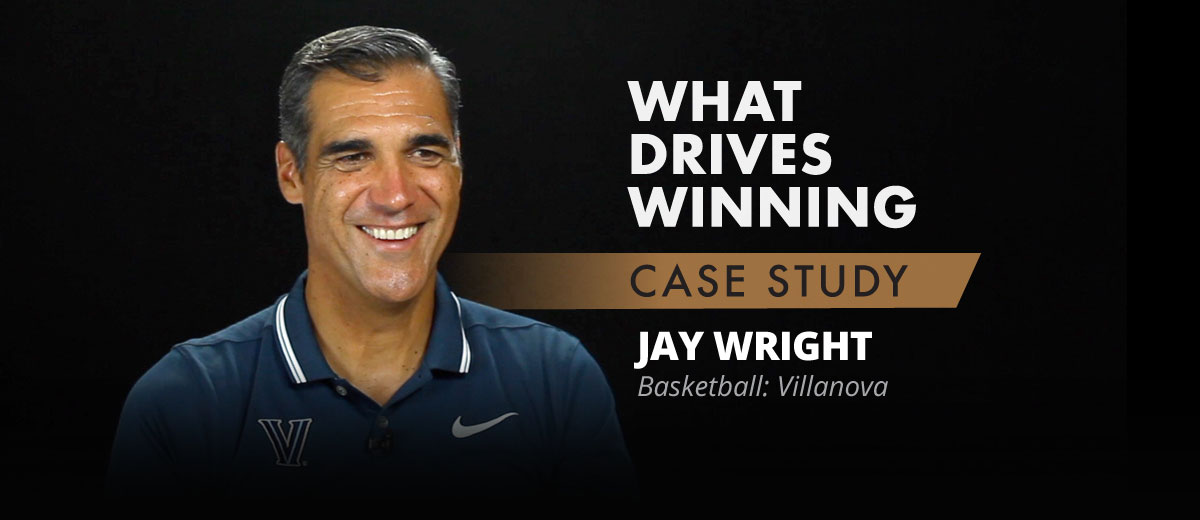
This is the first clip that I showed Jay Wright when we met:
What do you take from that?
What was the Wizard of Oz doing?
He was projecting an image.
That image is different than the real self.
The goal of this case study is to pull the curtain back on the human experience of Jay’s path.
That being said, let’s look at his last five years of coaching:
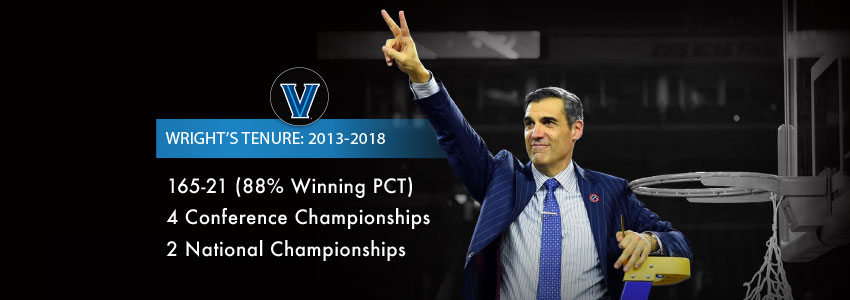
That’s the best resume in Division I basketball over that time span.
Now, let’s look at the first five years of Jay’s career:
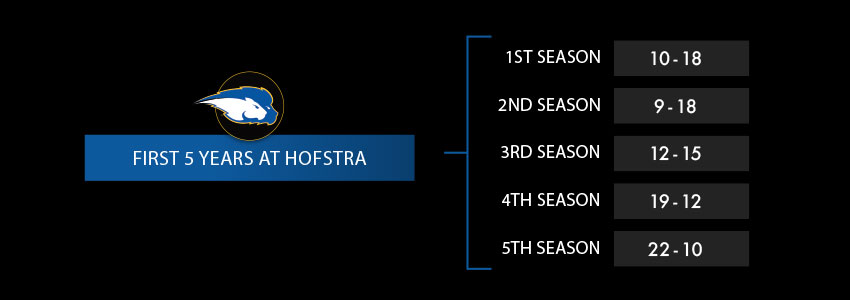
Much different experience.
After year, three, there were rumblings of him getting fired. Here’s what he said to himself.
What’d you say to yourself in year 3?
Year 4, Jay started to do it his way.
He describes that.
What was your way?
He surrendered to the outcome and made it about how they played.
He actually turned the ship around. We’ll get into that in a second, but before we do, I asked Jay what it was like to be married to him those first three years at Hofstra.
What’s it like to be married to you those first three years?
Patti Wright (Jay’s wife) anchored him into a reality that was much different then the perception of what his life actually was.
And to that point, I wanted to show Jay a clip from the 2018 conference in Chicago.
It’s a clip that I did with Bob Stoops.
Take a look at his reaction.
Thoughts on what Bob says?
Why do you think Jay had that kind of reaction?
When he meets people, he gets to see the perception that they have for him.
It’s different than his reality.
Jay sees that gap—and he knows there’s not enough time to close it. So what happens?
He signs the autograph, takes the selfie, and the cycle perpetuates.
Jay remembers when it started to go downhill.
When did it go downhill for you?
Jay became an institutional ambassador and he was pedaled to different place to speak.
The treadmill got faster and faster.
Here’s an event that woke him up.
Was there an event that woke you up?
And as soon as Jay said that to me, I thought of a clip with Urban Meyer.
I showed Jay that clip to get his reaction.
Thoughts on Urban?
Here’s where it slipped for Villanova.
Describe the slip.
At Hofstra, Jay had to find himself.
At Villanova, Jay lost himself.
He had to build it back with people that aligned with his vision.
After the Final Four, Jay learned something about recruiting.
He had access to talent that he never could access prior.
Here’s what happened.
What’s you learn about recruiting?
And Villanova is built on one word: Attitude.
There’s one question they ask to train that skill.
What question are you constantly asking?
And they train that.
So an example would be at practice, when they’re scrimmaging, they would have the coaches be road referees.
What happens when you play on the road?
You get bad calls.
The coaches are calling bad calls to see how the players respond.
That’s one example (of many) that show how they train that response.
Here’s a game example of what that looks like in action.
It’s from the 2016 National Championship game where they’re playing North Carolina.
UNC has the ball, there’s 13 seconds left, and they’re down by three.
One of the things that Villanova always talks about is:
Actors play to the crowd.
Players play for their team.
That response allows you to see who they’re playing for.
This is the huddle that followed that shot.
Describe the huddle after that shot goes in.
It didn’t end there.
This is the next play.
So to give you a scope on how big that shot was—here are a few reactions:
Charles Barkley:
Villanova Student Section:
Now, here’s Jay Wright’s reaction:
Jay had no reaction.
And that huddle is why.
He explains.
Explain why you didn’t have a reaction.
Can we agree that players can see anxiety in a coach’s eyes?
When Jay is feeling accomplished based on their response—he’s surrendered to the outcome.
What affect does that have on his players?
It frees them up to go and make a play—which is exactly what happened.
That’s how ATTITUDE affects the group on a team level.
That championship was a culmination of him redesigning his life.
Here’s how he created Villanova 2.0 both personally and professionally. (He never expected it to bring him a national championship.)
How did you redesign your life?
Saying, “No” has never been a strong suit of Jay’s. He had to master that skill in order to survive the residual requests that come from winning a championship.
As we mentioned earlier, Patti (Jay’s wife) helps ground him.
How does your wife ground you?
Jay found a way to slow it down.
Like he mentioned, he didn’t go to the ESPY’s after his team was nominated for Best Team.
One last story to show how Villanova 2.0 ATTITUDE benefited an athlete on an individual level.
Here’s a draft promo picture of Mikal Bridges.
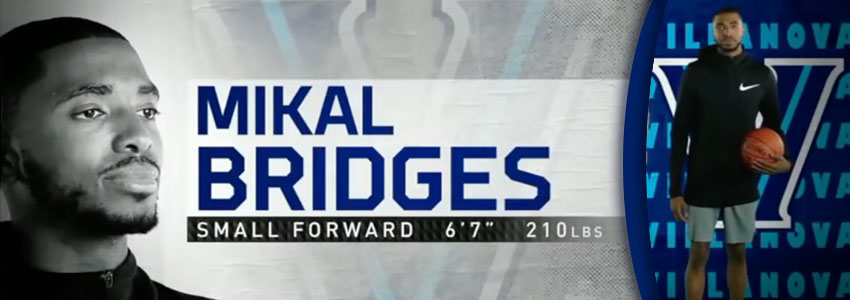
As you can see, Mikal entered the draft weighing 210 pounds.
He came to Villanova as a freshman weighing 170 pounds.
He got banged around and agreed to redshirt.
The next year, he embraced his role of not starting and was the National sixth man of the year for a National Championship team.
His sophomore year he continues to improve.
As a redshirt junior, he takes an interest in developing his teammates around him and leads them to his second national championship in 3 years.
Then, this happens:
2018 NBA Draft
His mother is ecstatic. Here’s why:
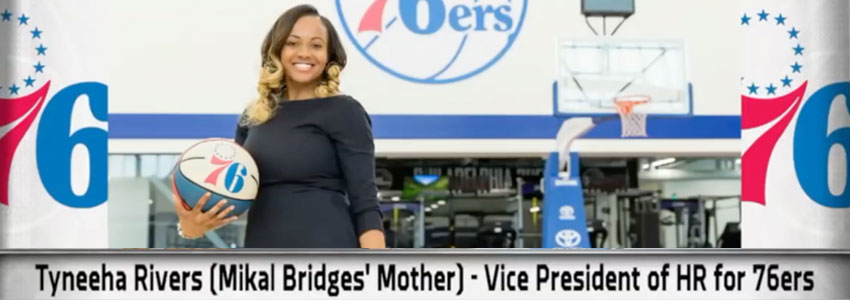
Mikal is ecstatic because he’s from Philly.
He dreamt of wearing a 76er jersey.
That creates a special moment for a family.
Then, this happens:
What happened next?
How incredible is that?
ATTITUDE — How do you respond when things don’t go your way?
Jay Wright has built a culture that helps the collective group navigate moments as a team as well developing the individuals inside it with the same skill.
He’s done that by centering his life on what’s really important to him and letting that guide where he invests his energy.